
Why I Built TheToonMaker: Directing Without the Fight
If you have ever felt that your idea was strong, but the process wore you down, this story will probably sound familiar. I have been there too: full of energy to tell something, and stuck facing too many barriers between the idea and the finished scene. In this article, I want to share why I built TheToonMaker and the real problem I wanted to solve.
I know the hard side of making animation
My name is Ivan, and I have spent years working with moving images. I started in editing, then moved into effects, 3D, scene-building tools, and later, AI. I love every one of those disciplines, but I also learned something very clear: making animation can be beautiful and exhausting at the same time.
The hard part is rarely the idea. The hard part is everything that happens before the edit. First you build the characters, then you prepare them to move, define the sets, the cameras, the light, the voices, and the timing. Only after that do you finally sit down to edit.
The problem is that each part usually lives in a different tool. If you change a pose, you may need to redo another piece. If you change the angle, continuity can break. If you change the pace, you go back again. Over time, I watched very talented people leave projects not because they lacked ideas, but because the process drained them.
The question that stayed with me for years
The question was simple: why should one person carry all of it? A real studio does not work that way. A studio works because there are specialists, clear roles, and a hierarchy that holds the project together.
That is when the direction became obvious to me. I did not want to invent another layer of complexity. I wanted to recreate the logic of a studio inside a simple platform. A place where someone could come in with an idea and a drawn character, and leave with an animated scene they felt proud of.
That became the core of TheToonMaker.
What makes TheToonMaker different?
I did not want the platform to feel like a box full of buttons. I wanted it to feel like a team.
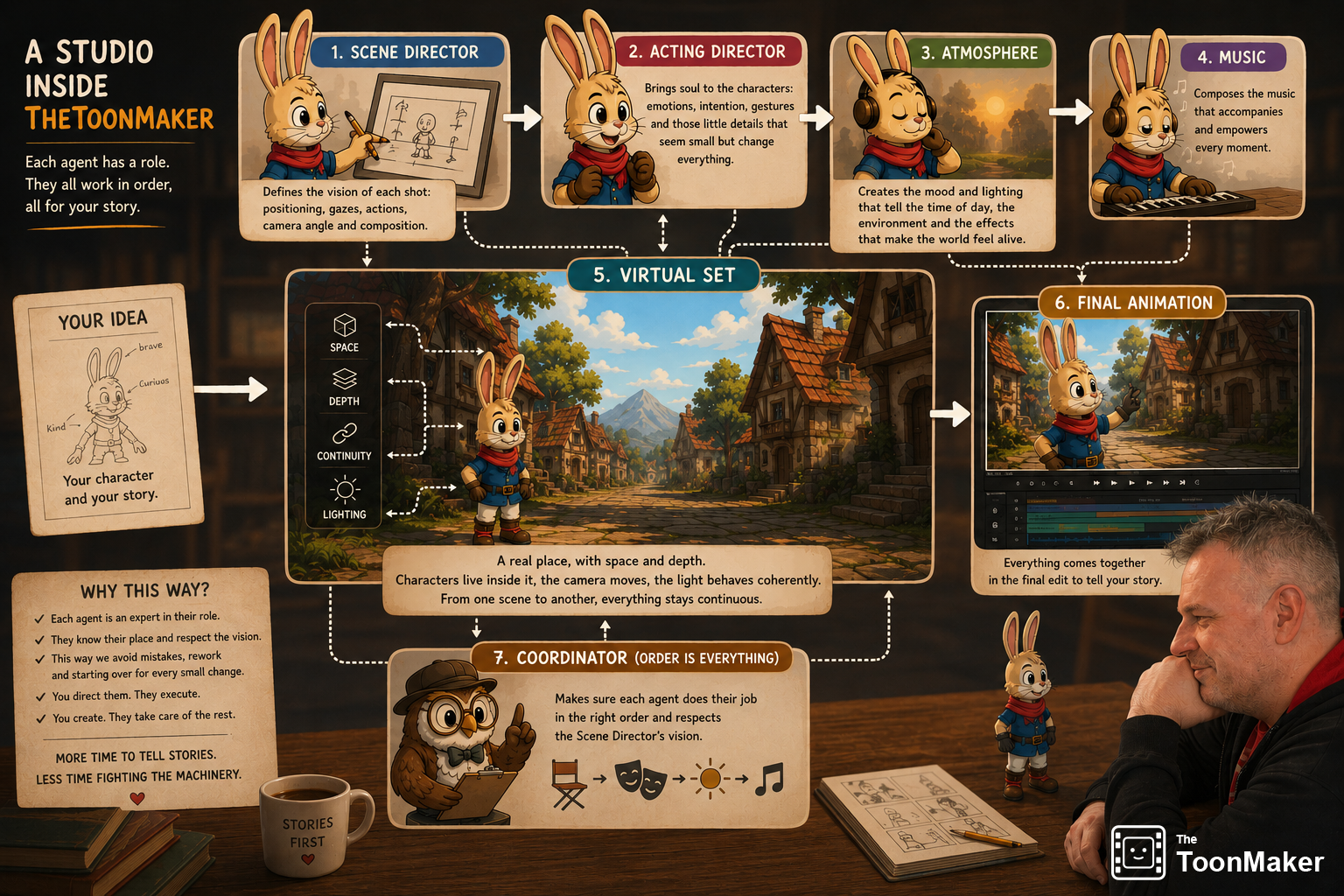
Inside TheToonMaker, each assistant has a clear role:
- Scene Director: sets the vision for each shot.
- Performance Director: handles the small details that make a character feel alive.
- Atmosphere: helps shape weather, light, effects, and music.
What mattered most to me was hierarchy. The Scene Director sets the direction. The camera follows the scene. The Performance Director works inside that frame, not against it. When each role has clear limits, changes stop breaking the whole project.
In real productions, that clarity saves time and avoids frustration. And for someone working alone or with a small team, that time savings changes everything.
How does a studio fit inside one tool?
Think of it like building a scene with a team of people who know their jobs, without having to coordinate ten people yourself.
You do not need to think through every technical step first. You can focus on what matters at the start:
- Your idea.
- Your character.
- The tone of the scene.
- The feeling you want to create.
Then the platform helps organize the rest so the scene keeps moving without chaos. The point is not to replace creativity. The point is to remove the things that slow it down.
The Virtual Set is not a flat background
One of the most important things I wanted to build was the Virtual Set. For me, it was essential that the world would not feel like a simple background pasted behind a character.
I wanted space, depth, and continuity. I wanted a character to stay inside the same world from one scene to the next, like in a real shoot. If the creator describes a place, the set is built with that logic, and the world takes shape around the story.
That makes a huge difference. When the space stays consistent, the story breathes better. And when the story breathes better, the audience feels that world is real.
Why does performance matter so much?
Because an animated scene does not only need motion. It needs feeling.
A character can have the right pose and still feel empty. It can be framed well and still say nothing. That is where the Performance Director comes in, and for me, that is the heart of the system.
I like to think of this role as caring for the invisible parts:
- a pause before answering,
- a tiny head tilt,
- a gesture that changes the mood,
- a small reaction that makes the character believable.
Those details are what turn a correct sequence into a memorable scene.
What I learned while building this
Building TheToonMaker taught me a few lessons I do not want to forget.
1) Simplicity is the hardest thing to build
Making something easy for the creator usually takes a lot of work behind the scenes. Simple does not happen by accident. It is designed, tested, corrected, and tested again.
2) AI works better when it has a clear role
When each part knows why it exists, everything flows better. You do not need one tool to do the work of an entire studio. It is better to give each piece a specific job.
3) What I missed most was not technical control
What I missed most was time to experiment. Time to try a strange idea. Time to see whether a gesture works. Time to play a little more before closing a scene.
And that is exactly what I want TheToonMaker to give back: time to create.
If you want to try it without the friction
If you have an idea, a character, or even just a scene in your head, you can start today and see how far it goes. Create your first animated short free at TheToonMaker and turn a loose idea into a scene that feels alive.
What I wanted you to feel when using it
I wanted someone with no experience in animation software to sit down, bring a drawing on a napkin and a story in their head, and watch that character come to life inside its own world.
Without fighting every step. Without learning a huge process before getting started. Without feeling like the tool is bigger than the idea.
That is the promise that matters to me.
In short
- The hardest part of animation is not imagining it, but carrying the process before the edit.
- TheToonMaker was built to feel like a small studio, with clear roles and useful hierarchy.
- The goal is simple: give you more time to tell stories and less time spent wrestling with the machinery.
If you want to move from idea to scene without getting lost in unnecessary steps, start free now and publish your first scene today.
"Me pasé media vida aprendiendo a hacer esto difícil; mi trabajo ahora es que para ti sea fácil."
— Ivan